THE hunt is on to find out if a bloodthirsty crocodile really is lurking in the River Lea. A Leyton and Leytonstone Guardian exclusive last week revealed that the reptile could have been responsible for snatching a large Canada goose from the river, near the Lea Interchange in Leyton. Since then reports have come in that the peckish beast may be taking its pick from the river's rich menu of wildlife. Five cygnets have been reported missing to the Lea Rivers Trust and tales of dogs being snatched from the riverbank are doing the rounds among local fishermen.
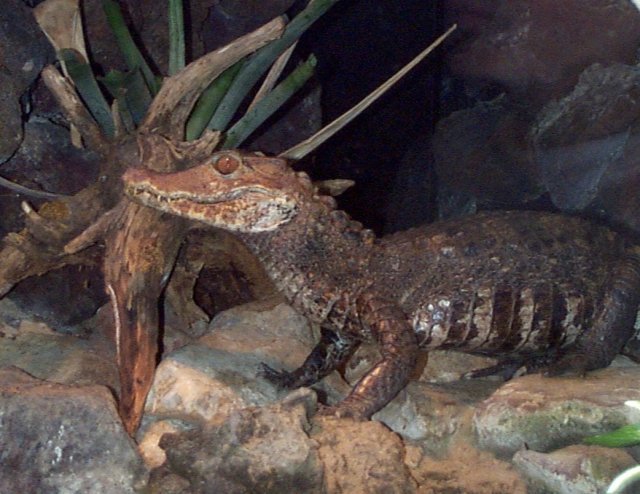
SPECTACLED CAIMAN A man who paid £20 in an Essex pub for what he thought was an exotic lizard ran into trouble as the creature turned out to be a Spectacled Caiman - a type of Crocodile. The Caiman - christened Carmen - was only 12 inches long when it was rescued in June 2000, but at full size could grow up to seven feet in length. When found it was severely underweight, had an infected stub on its broken tail and had two claws missing. Caimans, which require being housed in tropical conditions and fed a diet of fish and meat, have an aggressive nature.
An alligator, which lived most of his life in a building in the back garden of a house in Greater Manchester, is starting a new life in Spain, thanks to the RSPCA. Samson, a six-foot American alligator, has lived in a purpose-built home attached to the conservatory of his owner’s house in Bury for 27 years. August 2002
Two-inch 'pet lizard' grows into crocodile by Tom Sykes and Peter Gruner June 14, 2001
A North London man whose son swapped a fish for what he thought was a small lizard had to call in the RSPCA when the animal grew into a crocodile and bit him - and could have killed him. The boy had in fact been given a baby spectacled cayman, capable of growing to more than 7 feet and more suited to feasting on the flesh of large birds and mammals in South American swamps than a terraced house in Palmers Green. When the boy, a keen fish breeder, first obtained the cayman, which is listed as a dangerous wild animal and has to be registered with the authorities, it was only two inches long. Over the next 18 months it grew and grew until it was two-and-a half feet. The crocodile was kept in a four-foot tank half filled with water - although caymans need dry land to bask on in order to be fit and healthy.
Inspector Ian Briggs RSPCA officers rescued a five-foot alligator from a flat in Chesterfield, where it had been living in a pond liner in a bedroom measuring just ten feet square.Louis the Mississippi alligator was imported from America to live in a British zoo, before he was sold to a pet shop and then snapped up by an exotics’ collector. However, the alligator’s new owner, who did not have a DWA licence, quickly found he was unable to cope with the creature.RSPCA Inspector Ian Briggs said: “Alligators like Louis can grow up to 12 feet in length. Clearly, a flat is a totally unsuitable environment for an animal such as this. The alligator was not licensed so there was no mechanism in place for either its welfare or safety issues to be monitored.”The DWA Act must be tightened up so that animals such as this do not slip through the net.” Louis, who was rescued from the flat in December 1999, is now being cared for at Thrigby Hall Wildlife Gardens, a specialist exotics centre in North Norfolk.
There is also a strange link between crocs and one of the ancient Welsh lake monsters the Affanc. More on this later.
The idea of an escaped crocodile of some variety might seem bizarre but I already knew the CFZ had been called out before on exactly these kind of hunts. Increasing numbers of people were dumping crocs in rivers and lakes and keeping them illegally at home. The RSPCA society rescued more than 40 alligators and crocodiles between 2000-5.
A major CFZ expedition was to Roman Lake near that central point of weirdness Cannock Chase in 2003 where:
John Mizzen, his Daughter Linda Charteris and his three young granddaughters encountered something which was large and alive. John had taken his family to the waters edge to feed a pair of Swans and their Cygnets. Following a substantial underwater commotion a head appeared on the surface. It scared the three children and unnerved Linda. John could only describe it in one way. Alligator. Both John and Linda thought it was after the Cygnets. Distracted by the frightened children Linda only saw it for a few seconds, but was insistent it was large dark coloured flat head, moving silently through the water. John had a longer look, and estimated that the body was five feet long and the tail two feet.
Roman Lake in Staffordshire Photo from Beastwatch's report on the incident.
Accounts of that hunt provided useful background:
As I’ve said it is not unknown for Crocodilians to be in this country (completely illegal, in contravention of the 1976 Dangerous Animals act, and sometimes, laws against exploiting endangered species).
Because of its relatively small size, African Dwarf Crocodiles (Osteolaemus tetraspis) have become popular the world over as novelty pets. An endangered species, from West and tropical Africa they grow to a maximum of about five feet. Ten of these were confiscated, very recently, by customs Officers at Heathrow airport. They were smuggled, on a flight from Nigeria, stuffed into sacks in the aircrafts hold. All ten animals survived.
Above Dwarf Caiman
The Speckled Caiman (Caiman Crocodilius) originates from South America and grows up to seven feet in length. In September 2002 Police and the RSPCA retrieved two such animals from a squalid Oldham council flat. Another story, sounding like the introduction to a joke, but true, is of a fellow who bought a “Lizard” in a sack, from a man in an Essex pub. The moron paid £20 and staggered home. Once sober he discovered he was the owner of a Speckled Caiman.
Below Spectacled Caiman Caiman crocodilus
A five foot long American Alligator (Alligator mississippiensis), was found a few years ago in a spare bedroom in Chesterfield. The unfortunate animal had been kept in pond liner for years. After being rescued it was sent to a Norfolk Wildlife Park. The American Alligator is by far the largest of the Crocodilians I have mentioned here, the largest males grow up to about fifteen feet, and if tales spun by everglades moon shiners are to be believed, up to twenty feet, (although I’m not suggesting for one moment anything close to that size is at large in Roman View Lake).
Stacey Clayton spotted the 2ft (61cm) caiman on Saturday at St Andrew's pond in St Blazey.
The animal has not been found, but the RSPCA believes it could be hiding in nearby marshland and has warned local people to be careful in the area.
A reptile expert from Newquay Zoo believes the caiman could be an unwanted pet which has been dumped.
It's certainly not going to attack or chase a human being, but if you tried to get hold of it, it could bite you
John Meek, Newquay Zoo
Ms Clayton said: "I noticed this big log bopping up and down in the water, but as I got closer to it, it blinked and I could see its eyes.
"I wasn't sure whether it was alive or not so I threw a small stone near it and as it moved I could see it was a caiman - about 2ft long - so I dashed home and called the RSPCA."..
The RSPCA said the incident highlighted the growing problem of people keeping exotic animals with little or no knowledge of the specialist care and attention they require. The society has rescued more than 40 alligators and crocodiles since 2000.
The CFZ also looked for it as this report shows Monster Hunters Snappy Visit. None of these hunts turned up anything solid. This may be because the crocs had already died from the cold conditions. If there was such a reptile in the pond it needed immediate rescue as April in Wales would kill it soon.
But it also seems possible these sightings may be a case of mistaken identity as it could be a large fish is to blame for the Crocodile sightings. Here there were various candidates such as Sturgeon which Richard had mentioned to me on the phone.
There is a particular fish, which is absolutely enormous, the Sturgeon, which can look like a Crocodile, especially from the top.” I based my comments on the original witnesses report to the local Police and RSPCA; they were five members of a local family.I do not think my statement that the Cygnet Cruncher possibly being a Sturgeon too unreasonable. We even have a precedent from Loch Ness Monster lore. Naturalist and Loch Ness ecology expert, Adrian Shine believes that misidentified Sturgeon could be Nessie herself, the Queen of all Monsters. He thinks they enter the Loch via the river Ness in search of mates. He supports his argument with a case from 1932. Miss K Macdonald saw an 8 foot long creature splashing up the river Ness. The description was remarkably similar to a Crocodile. Shine thinks that this “Crocodile” was in fact, a Sturgeon.
This fish could be huge no wonder it was a good candidate for Nessie. "In 1987 a Sturgeon, eleven feet (3.35 m) long and weighing 900 lbs (408 kg) was found dead, floating in Lake Washington near Seattle, U.S.A., where stories of a 'Monster' had circulated (Albuquerque Journal, 7th November 1987)."
The fish shown above was washed up in Lake Washington and was 3.5m (11 feet) long.
For more see: Research Loch Ness - Adrian Shine - Sturgeon or Surgeon. With its bony ridge it also could look a croc from a distance. "Against the sturgeon is that the European sturgeon is not known to spend long periods in fresh water and the regular return of a giant sturgeon to Loch Ness would seem unlikely. The lake sturgeon is a different species and not found in the UK. Perhaps European sturgeon could adapt to fresh water, but that is not known." Another giant sturgeon can be seen here: But there are other aquatic monsters in British lakes:
Some thing struck a chord, in John and Linda’s account; it was the statement that the beast was after the Cygnets. This stirred a memory. Later in the day, after several local people told of large Pike (Esox lucius) in the lake, it came back. A couple or three decade ago, my Farther a keen and vastly experienced Angler, enthralled me with tales of this mighty predator. He told me that Pike pluck Wildfowl from the surface. Could a Pike be mistaken for a Crocodilian? I searched the triple double-u for Pike images, and was quite stunned by the remarkable similarity between a Pike and Crocs head. The eyes are on top; even the jaw line matches the sinister “Crocodile Smile”. But John said the animal was seven feet long, even allowing for a little adrenaline fuelled exaggeration, this would be a truly enormous specimen of E. lucius.
The largest officially recognised example weighed in at 67lb, (I can’t find any mention of its length, but according to the Pike Anglers Club of Great Britain, it would have been about five feet long). There are many claims of even bigger fish. Ireland, with its many ancient and largely undisturbed Loughs is home to numerous mammoth Pike legends. Claims of up to 90lbs have been made. There is one story from the Connamara region, in the North West of the country. It tells of a scuba diver who was terrified by a Pike, over six feet long.
Yet you don't need to go to Ireland for giant Pike. A previous CFZ expedition had located what appeared to be a monster pike in Langorse lake in Breconshire as this video shows:
Pluck Lake Croc - I conducted a search for this elusive Swansea beast in 2008 noted in national media - BBC, Daily Telegraph, Sun and Daily Mail.Basic details here - Croc identified! There have been other examples of UK Crocs. If you have any info on the Swansea Croc please leave a comment and contact details.




 It's certainly not going to attack or chase a human being, but if you tried to get hold of it, it could bite you

