Very hot weather in Swansea today but further investigations in last few days have revealed nlo trace nor have thee been any reports. However you can now watch online the CFZ Guyana expedition from November last year film report 1 hour 40 mins of it . They looked for three elusive, potentially lethal, and hitherto undiscovered animals. The Giant Anaconda, The Didi, The Water Tiger
It is interesting that the CFZ team not only saw Cayman being roasted on a fire in the expedition but also heard rumours of a new species as Jon Downes reports:
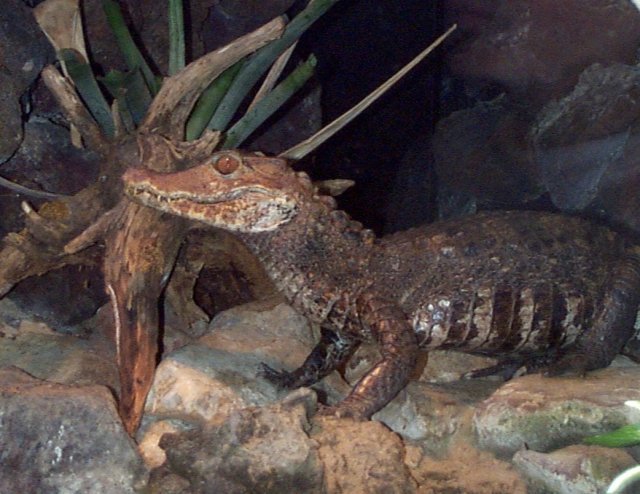
Ernest told them of another potential cryptid – and this, to the best of our knowledge – has never been reported before in the annuls of cryptozoology. He is very familiar with Cuvier’s dwarf cayman (Paleosuchus palpebrosus) – the smallest known species of the Alligatoridae, reaching a maximum size of a mere 1.5 metres. However, on two occasions, he has seen a tiny cayman, much smaller than the dwarf cayman, brown in colour, with a red stripe down its back. It bellowed loudly, and most peculiarly, he reported it has having two tails.
The expedition’s driver said that he had seen these creatures as well, and Ernest took them to a cave system near a river where he claims that these creatures live.
The team explored these caves, and although they found nothing in there, Richard – who is, after all, a crocodilian expert, and was, at one time, Head of Reptiles at Twycross Zoo in the West Midlands of England - says that, in his opinion, these caves are eminently suitable for a small crocodilian to aestivate in during the harsh months of the dry summer. For those of you not in the known, aestivation is basically the polar opposite of hibernation; going into a semi-dormant or dormant state to escape extremes of hot weather.
We suggested that the seemingly insoluble problem of the creature being reported with two tails could perhaps be indicative of it not being a cayman at all, but being some kind of huge salamander. When the tails of salamanders and newts have been injured, they sometimes grow back double. But then again, so do those of some lizards, so for the moment this must remain an enigma. However, it is an enigma which we hope will not stay that way for long. Richard and the team are going back to see Ernest this evening for dinner and we hope that they will be able to get some more information from him.
Weeding out the nonsense there are some useful comments on this story from the Swansea Evening Post's original story.
just a few mounths ago there was a report of a otter in there so it was probelt the same one there callum semmens 14, Neath
i am a little 15 year old boy i go fishing down the pluck i have never seen the crock and i am always down there so if it is there leave it alone please ffffffiiiisssshhh liam robins, swansea
I think it could well have been a mink or an otter, both are around 1m long and have a swimming profile that could be mistaken for a crocodile from a distance John, Swansea
It could be the pluck ness monster, in past summers you would be lucky to reel in a small tench from the pluck, normally it's just sprats like roach , rud and perch however I have seen some big things come out of the Pluck over ther years, namely cars and trollies however this monster would be a welcome catch on the worm... Scooter, Winch Wen Swansea
I have worked with reptiles in two zoos (Twycross and Tropiquaria) and have a soecial intrest in crocodillians. I have also nvestigated several cases of 'caimans' being seen in the midlands and i Cornwall. Nothing was ever found. A crocodillian could live in the UK during a warm summer but wopuld swiftly die come winter. It is possable people are mistaking a large sturgeon. Having said that several species of crocodillian have been caught in the uk over the years including Nile crocodile and specticaled caiman Richard Freeman, Devon
I worked at a large Reptile House for several years, and both calls and rescues involving crocodilians were fairly common. Unfortunately, when people get hold of these animals (usually illegally) as pets, they often get released into the wild when they become too much to look after, to avoid alerting the authorities. The best way to check would be to visit the lake at night, and with a torch held at eye level, scan the lake margins - if you see any pink or white eyeshine (like catseyes) then it is likely to be true! Dr James Reed, Yeovil
Approximately 2 years whilst walking my dog along the cycle path by the new bridge, opposite Ford's Plasmarl, I Saw a man staring in disbelief in the water, and as I looked myself I saw a tail disappearing into the water. This looked very much like a crocodile tail, which I commented, did you see that, and the man said people would not believe us if we told them, and walked off. So this has not been the first time, as also my wife and myself on another occasion with the dog saw what looked like a log in the water, but it slowly went down, out of sight, and we felt quite spooked. We believe quite strongly there is a crocodile there, and this should be taken far more seriously by the authorities than it is at present. We also do not want our e mail address printed as we would leave ourselves wide open to prank calls jamming up our e mails, but print the letter by all means. Concerned dog walker, Swansea
At around 7 pm I talked to Steve Jenkins at the Lake. What he told me further convinced me we are dealing with a member of the Crocodile family. I now know exactly where he stood and from where he saw the animal at that distance of roughly 3-4 m he could not have been mistaken especially as he is a fisherman and he noted the animals legs. The water was calm and the day was clear and fairly sunny.
From his description and what he thinks after showing him Croc photos it seems likely what he saw was a Spectacled Caiman. He described what seemed to be the characteristic bony ridge between its eyes. As that is a popular species for pets that makes sense. The main other possibility is perhaps an American alligator. I think he saw something like this:
From Hungry Hyaena website - "One of the adult spectacled caiman (Caiman crocodilus) disturbed by my wading in pousada bahia (Pousada Ararauna, Pantanal, Brasil)"
You can see where he was roughly from the map above. The blue man was his first location and the green man is Steve's finally location as is the fish is the croc. The war level today is much higher than on the satellite photo.
I also talked to Jon Downes, the Director, at the CFZ. He feels that the chances of a Croc surviving for any length of time are bleak in April. CFZ has been on a number of UK croc hunts in the last few years. He also filled me in on further on the illegal trade in crocs and other exotics. Alligators are easy to buy in Florida and were easy to smuggle back in hand luggage. It is tougher since 9/11 but perhaps in South America where Caimans come from security is not so tight. There is certainly an underground trade in place inside the UK. Furthermore he told me about 3 crocodile bodies that have been found in British waterways and ponds in recent times.
The Sun, and Swansea Evening Post are doing more on this story today.
More updates to come keep watching this blog. Please come forward if you seen anything.
The idea of an escaped crocodile of some variety might seem bizarre but I already knew the CFZ had been called out before on exactly these kind of hunts. Increasing numbers of people were dumping crocs in rivers and lakes and keeping them illegally at home. The RSPCA society rescued more than 40 alligators and crocodiles between 2000-5.
A major CFZ expedition was to Roman Lake near that central point of weirdness Cannock Chase in 2003 where:
John Mizzen, his Daughter Linda Charteris and his three young granddaughters encountered something which was large and alive. John had taken his family to the waters edge to feed a pair of Swans and their Cygnets. Following a substantial underwater commotion a head appeared on the surface. It scared the three children and unnerved Linda. John could only describe it in one way. Alligator. Both John and Linda thought it was after the Cygnets. Distracted by the frightened children Linda only saw it for a few seconds, but was insistent it was large dark coloured flat head, moving silently through the water. John had a longer look, and estimated that the body was five feet long and the tail two feet.
Roman Lake in Staffordshire Photo from Beastwatch's report on the incident.
Accounts of that hunt provided useful background:
As I’ve said it is not unknown for Crocodilians to be in this country (completely illegal, in contravention of the 1976 Dangerous Animals act, and sometimes, laws against exploiting endangered species).
Because of its relatively small size, African Dwarf Crocodiles (Osteolaemus tetraspis) have become popular the world over as novelty pets. An endangered species, from West and tropical Africa they grow to a maximum of about five feet. Ten of these were confiscated, very recently, by customs Officers at Heathrow airport. They were smuggled, on a flight from Nigeria, stuffed into sacks in the aircrafts hold. All ten animals survived.
Above Dwarf Caiman
The Speckled Caiman (Caiman Crocodilius) originates from South America and grows up to seven feet in length. In September 2002 Police and the RSPCA retrieved two such animals from a squalid Oldham council flat. Another story, sounding like the introduction to a joke, but true, is of a fellow who bought a “Lizard” in a sack, from a man in an Essex pub. The moron paid £20 and staggered home. Once sober he discovered he was the owner of a Speckled Caiman.
Below Spectacled Caiman Caiman crocodilus
A five foot long American Alligator (Alligator mississippiensis), was found a few years ago in a spare bedroom in Chesterfield. The unfortunate animal had been kept in pond liner for years. After being rescued it was sent to a Norfolk Wildlife Park. The American Alligator is by far the largest of the Crocodilians I have mentioned here, the largest males grow up to about fifteen feet, and if tales spun by everglades moon shiners are to be believed, up to twenty feet, (although I’m not suggesting for one moment anything close to that size is at large in Roman View Lake).
Stacey Clayton spotted the 2ft (61cm) caiman on Saturday at St Andrew's pond in St Blazey.
The animal has not been found, but the RSPCA believes it could be hiding in nearby marshland and has warned local people to be careful in the area.
A reptile expert from Newquay Zoo believes the caiman could be an unwanted pet which has been dumped.
It's certainly not going to attack or chase a human being, but if you tried to get hold of it, it could bite you
John Meek, Newquay Zoo
Ms Clayton said: "I noticed this big log bopping up and down in the water, but as I got closer to it, it blinked and I could see its eyes.
"I wasn't sure whether it was alive or not so I threw a small stone near it and as it moved I could see it was a caiman - about 2ft long - so I dashed home and called the RSPCA."..
The RSPCA said the incident highlighted the growing problem of people keeping exotic animals with little or no knowledge of the specialist care and attention they require. The society has rescued more than 40 alligators and crocodiles since 2000.
The CFZ also looked for it as this report shows Monster Hunters Snappy Visit. None of these hunts turned up anything solid. This may be because the crocs had already died from the cold conditions. If there was such a reptile in the pond it needed immediate rescue as April in Wales would kill it soon.
But it also seems possible these sightings may be a case of mistaken identity as it could be a large fish is to blame for the Crocodile sightings. Here there were various candidates such as Sturgeon which Richard had mentioned to me on the phone.
There is a particular fish, which is absolutely enormous, the Sturgeon, which can look like a Crocodile, especially from the top.” I based my comments on the original witnesses report to the local Police and RSPCA; they were five members of a local family.I do not think my statement that the Cygnet Cruncher possibly being a Sturgeon too unreasonable. We even have a precedent from Loch Ness Monster lore. Naturalist and Loch Ness ecology expert, Adrian Shine believes that misidentified Sturgeon could be Nessie herself, the Queen of all Monsters. He thinks they enter the Loch via the river Ness in search of mates. He supports his argument with a case from 1932. Miss K Macdonald saw an 8 foot long creature splashing up the river Ness. The description was remarkably similar to a Crocodile. Shine thinks that this “Crocodile” was in fact, a Sturgeon.
This fish could be huge no wonder it was a good candidate for Nessie. "In 1987 a Sturgeon, eleven feet (3.35 m) long and weighing 900 lbs (408 kg) was found dead, floating in Lake Washington near Seattle, U.S.A., where stories of a 'Monster' had circulated (Albuquerque Journal, 7th November 1987)."
The fish shown above was washed up in Lake Washington and was 3.5m (11 feet) long.
For more see: Research Loch Ness - Adrian Shine - Sturgeon or Surgeon. With its bony ridge it also could look a croc from a distance. "Against the sturgeon is that the European sturgeon is not known to spend long periods in fresh water and the regular return of a giant sturgeon to Loch Ness would seem unlikely. The lake sturgeon is a different species and not found in the UK. Perhaps European sturgeon could adapt to fresh water, but that is not known." Another giant sturgeon can be seen here: But there are other aquatic monsters in British lakes:
Some thing struck a chord, in John and Linda’s account; it was the statement that the beast was after the Cygnets. This stirred a memory. Later in the day, after several local people told of large Pike (Esox lucius) in the lake, it came back. A couple or three decade ago, my Farther a keen and vastly experienced Angler, enthralled me with tales of this mighty predator. He told me that Pike pluck Wildfowl from the surface. Could a Pike be mistaken for a Crocodilian? I searched the triple double-u for Pike images, and was quite stunned by the remarkable similarity between a Pike and Crocs head. The eyes are on top; even the jaw line matches the sinister “Crocodile Smile”. But John said the animal was seven feet long, even allowing for a little adrenaline fuelled exaggeration, this would be a truly enormous specimen of E. lucius.
The largest officially recognised example weighed in at 67lb, (I can’t find any mention of its length, but according to the Pike Anglers Club of Great Britain, it would have been about five feet long). There are many claims of even bigger fish. Ireland, with its many ancient and largely undisturbed Loughs is home to numerous mammoth Pike legends. Claims of up to 90lbs have been made. There is one story from the Connamara region, in the North West of the country. It tells of a scuba diver who was terrified by a Pike, over six feet long.
Yet you don't need to go to Ireland for giant Pike. A previous CFZ expedition had located what appeared to be a monster pike in Langorse lake in Breconshire as this video shows:
Pluck Lake Croc - I conducted a search for this elusive Swansea beast in 2008 noted in national media - BBC, Daily Telegraph, Sun and Daily Mail.Basic details here - Croc identified! There have been other examples of UK Crocs. If you have any info on the Swansea Croc please leave a comment and contact details.




 It's certainly not going to attack or chase a human being, but if you tried to get hold of it, it could bite you

