It is interesting to note there is a term for what has happened.
The appearance of alligators and crocodiles in areas far from their native habitat is known in Forteana as the crazy croc syndrome or the crazy crocs. It is a problem which goes back many years see here:
2005 has been a bumper year for crazy croc incidents, with reports from areas as diverse as South Seattle, Wash., Rehoboth, Mass. and Charleston, West Virginia... (Editor's Comment: We've had isolated crazy croc sightings in the USA before. Fortean researcher Loren Coleman has documented hundreds of them dating back to the early 1930s. But, to my knowledge, this is the first sustained crazy croc flap we've ever had, with sightings every week.)
Another incident in 2005 was in Cyprus - "Wildlife workers in Cyprus are trying to verify reports that crocodiles may be on the loose at a popular tourist nature spot after they became too dangerous for their owner to handle."
"The reptiles are believed to have been smuggled in to the eastern Mediterranean island, where crocodiles do not breed and the closest nature cousin is the innocuous chameleon."
This is the fourth report in three weeks about out-of-place crocodiles or alligators turning up in areas far from their natural habitat.
Another interesting sighting was an Alligator in Maine in September 2000 a pretty unseasonable time one would have thought:
OUT-OF-PLACE ALLIGATOR SNAPS AT A MAN IN KENNEBUNKPORT, MAINE
One of the weirdest Fortean phenomena is the "Crazy Croc syndrome," the sudden and unexplained appearance of alligators in places far from their natural habitat.
Just such an incident occurred last week in Kennebunkport, Maine (population 1,200), a seaside resort town on Route 9 located about 26 miles (40 kilometers) south of Portland.
(Editor's Note: The Bush family mansion, summer home of former President George Herbert Walker Bush, and his son, Gov. George W. Bush, the current Republican Party candidate for USA president, is located on Walker's Point in Kennebunkport.)
(Editor's Comment: Cue spooky organ music...) "An alligator that nipped at a man's trousers was likely someone's pet that was set free, police said."
"William Sartry shot the 31-inch-reptile dead. He said the alligator approached him while he was walking around a pond in his back yard."
"'You're going to think I'm nuts,' Sarty told a police dispatcher when he reported the incident." (See USA Today for September 20, 2000, "Maine," page 6A.) from
As always Charles Fort was the first to notice Crazy Croc Syndrome in his book LO!:
Maybe, in September, 1929, somebody lost an alligator. According to some of our data upon the insecurities of human mentality, there isn't anything that can't be lost by somebody. A look at Losts and Founds -- but especially Losts -- confirms this notion. New York American, Sept. 19, 1929 -- an alligator, 31 inches long, killed in the Hackensack Meadows, N.J., by Carl Weise, 14 Peerless Place, North Bergen, N.J. But my attention is attracted by another "mysterious appearance" of an alligator, about the same time. New York Sun, Sept. 23, 1929 -- an alligator, 28 inches long, found by Ralph Miles, in a small creek, near Wolcott, N.Y.
In the Gentleman's Magazine, Aug., 1866, somebody tells of a young crocodile, which, about ten years before, had been killed on a farm, at Over-Norton, Oxfordshire, England.
In the November issue of this magazine, C. Parr, a well-known writer upon antiquarian subjects, says that, thirty years before, near Chipping Norton, another young crocodile had been killed.(6) According to Mr. Parr, still another young crocodile had been seen, at Over-Norton. In the Field, Aug. 23, 1862, is an account of a fourth young crocodile that had been seen, near Over-Norton.(7)
It looks as if, for about thirty years, there had been a translatory current, especially selective of young crocodiles, between somewhere, say in Egypt, and an appearing-point near Over-Norton. If, by design and functioning, in the distribution of life in an organism, or in one organic existence, we mean anything so misdirected as a teleportation of young crocodiles to a point in a land where they would be out of adaptation, we evidently mean not so very intelligent design and functioning. Possibly, or most likely. It seems to me that an existence that is capable of sending young butchers to medical schools, and young boilermakers to studios, would be capable of sending young crocodiles to Over-Norton, Oxfordshire, England.
Fort thinks telportation (a word he invented) might be involved. It is interesting that so many Crocs should have been seen in the 1860s in one area.
Earlier this evening we went croc hunting. Why at night? Well thats one of the best time to look according to experts. Most crocs are nocturnal hunters and as Crocs eyes strongly reflect light, even from a distance, anyone searching for crocs finds that using lights to scan the water for their eye-shine is the best way to spot them at night allowing you to see their glowing red eyes. This eye-shine comes from a special crystal layer at the back of their eye called the "tapetum lucidum" which reflects light. Crocodiles have excellent night vision as a result of this layer.
Did we find the croc? No but we do have some interesting photos. To be honest the search was a long shot I think from what I have discovered it is either dead or has hidden itself very well and won't be moving until the temperature gets into the 20s. More results from the search to come.
By the way I have noted famed cryptozoologist and CFZ member Nick Redfern has noted us on his blog thanks to Siani. See here:A Welsh Crocodile
The idea of an escaped crocodile of some variety might seem bizarre but I already knew the CFZ had been called out before on exactly these kind of hunts. Increasing numbers of people were dumping crocs in rivers and lakes and keeping them illegally at home. The RSPCA society rescued more than 40 alligators and crocodiles between 2000-5.
A major CFZ expedition was to Roman Lake near that central point of weirdness Cannock Chase in 2003 where:
John Mizzen, his Daughter Linda Charteris and his three young granddaughters encountered something which was large and alive. John had taken his family to the waters edge to feed a pair of Swans and their Cygnets. Following a substantial underwater commotion a head appeared on the surface. It scared the three children and unnerved Linda. John could only describe it in one way. Alligator. Both John and Linda thought it was after the Cygnets. Distracted by the frightened children Linda only saw it for a few seconds, but was insistent it was large dark coloured flat head, moving silently through the water. John had a longer look, and estimated that the body was five feet long and the tail two feet.
Roman Lake in Staffordshire Photo from Beastwatch's report on the incident.
Accounts of that hunt provided useful background:
As I’ve said it is not unknown for Crocodilians to be in this country (completely illegal, in contravention of the 1976 Dangerous Animals act, and sometimes, laws against exploiting endangered species).
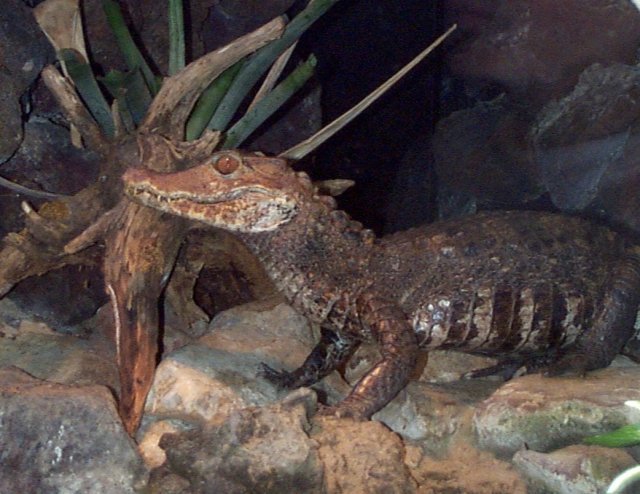
Because of its relatively small size, African Dwarf Crocodiles (Osteolaemus tetraspis) have become popular the world over as novelty pets. An endangered species, from West and tropical Africa they grow to a maximum of about five feet. Ten of these were confiscated, very recently, by customs Officers at Heathrow airport. They were smuggled, on a flight from Nigeria, stuffed into sacks in the aircrafts hold. All ten animals survived.
Above Dwarf Caiman
The Speckled Caiman (Caiman Crocodilius) originates from South America and grows up to seven feet in length. In September 2002 Police and the RSPCA retrieved two such animals from a squalid Oldham council flat. Another story, sounding like the introduction to a joke, but true, is of a fellow who bought a “Lizard” in a sack, from a man in an Essex pub. The moron paid £20 and staggered home. Once sober he discovered he was the owner of a Speckled Caiman.
Below Spectacled Caiman Caiman crocodilus
A five foot long American Alligator (Alligator mississippiensis), was found a few years ago in a spare bedroom in Chesterfield. The unfortunate animal had been kept in pond liner for years. After being rescued it was sent to a Norfolk Wildlife Park. The American Alligator is by far the largest of the Crocodilians I have mentioned here, the largest males grow up to about fifteen feet, and if tales spun by everglades moon shiners are to be believed, up to twenty feet, (although I’m not suggesting for one moment anything close to that size is at large in Roman View Lake).
Stacey Clayton spotted the 2ft (61cm) caiman on Saturday at St Andrew's pond in St Blazey.
The animal has not been found, but the RSPCA believes it could be hiding in nearby marshland and has warned local people to be careful in the area.
A reptile expert from Newquay Zoo believes the caiman could be an unwanted pet which has been dumped.
It's certainly not going to attack or chase a human being, but if you tried to get hold of it, it could bite you
John Meek, Newquay Zoo
Ms Clayton said: "I noticed this big log bopping up and down in the water, but as I got closer to it, it blinked and I could see its eyes.
"I wasn't sure whether it was alive or not so I threw a small stone near it and as it moved I could see it was a caiman - about 2ft long - so I dashed home and called the RSPCA."..
The RSPCA said the incident highlighted the growing problem of people keeping exotic animals with little or no knowledge of the specialist care and attention they require. The society has rescued more than 40 alligators and crocodiles since 2000.
The CFZ also looked for it as this report shows Monster Hunters Snappy Visit. None of these hunts turned up anything solid. This may be because the crocs had already died from the cold conditions. If there was such a reptile in the pond it needed immediate rescue as April in Wales would kill it soon.
But it also seems possible these sightings may be a case of mistaken identity as it could be a large fish is to blame for the Crocodile sightings. Here there were various candidates such as Sturgeon which Richard had mentioned to me on the phone.
There is a particular fish, which is absolutely enormous, the Sturgeon, which can look like a Crocodile, especially from the top.” I based my comments on the original witnesses report to the local Police and RSPCA; they were five members of a local family.I do not think my statement that the Cygnet Cruncher possibly being a Sturgeon too unreasonable. We even have a precedent from Loch Ness Monster lore. Naturalist and Loch Ness ecology expert, Adrian Shine believes that misidentified Sturgeon could be Nessie herself, the Queen of all Monsters. He thinks they enter the Loch via the river Ness in search of mates. He supports his argument with a case from 1932. Miss K Macdonald saw an 8 foot long creature splashing up the river Ness. The description was remarkably similar to a Crocodile. Shine thinks that this “Crocodile” was in fact, a Sturgeon.
This fish could be huge no wonder it was a good candidate for Nessie. "In 1987 a Sturgeon, eleven feet (3.35 m) long and weighing 900 lbs (408 kg) was found dead, floating in Lake Washington near Seattle, U.S.A., where stories of a 'Monster' had circulated (Albuquerque Journal, 7th November 1987)."
The fish shown above was washed up in Lake Washington and was 3.5m (11 feet) long.
For more see: Research Loch Ness - Adrian Shine - Sturgeon or Surgeon. With its bony ridge it also could look a croc from a distance. "Against the sturgeon is that the European sturgeon is not known to spend long periods in fresh water and the regular return of a giant sturgeon to Loch Ness would seem unlikely. The lake sturgeon is a different species and not found in the UK. Perhaps European sturgeon could adapt to fresh water, but that is not known." Another giant sturgeon can be seen here: But there are other aquatic monsters in British lakes:
Some thing struck a chord, in John and Linda’s account; it was the statement that the beast was after the Cygnets. This stirred a memory. Later in the day, after several local people told of large Pike (Esox lucius) in the lake, it came back. A couple or three decade ago, my Farther a keen and vastly experienced Angler, enthralled me with tales of this mighty predator. He told me that Pike pluck Wildfowl from the surface. Could a Pike be mistaken for a Crocodilian? I searched the triple double-u for Pike images, and was quite stunned by the remarkable similarity between a Pike and Crocs head. The eyes are on top; even the jaw line matches the sinister “Crocodile Smile”. But John said the animal was seven feet long, even allowing for a little adrenaline fuelled exaggeration, this would be a truly enormous specimen of E. lucius.
The largest officially recognised example weighed in at 67lb, (I can’t find any mention of its length, but according to the Pike Anglers Club of Great Britain, it would have been about five feet long). There are many claims of even bigger fish. Ireland, with its many ancient and largely undisturbed Loughs is home to numerous mammoth Pike legends. Claims of up to 90lbs have been made. There is one story from the Connamara region, in the North West of the country. It tells of a scuba diver who was terrified by a Pike, over six feet long.
Yet you don't need to go to Ireland for giant Pike. A previous CFZ expedition had located what appeared to be a monster pike in Langorse lake in Breconshire as this video shows:
Pluck Lake Croc - I conducted a search for this elusive Swansea beast in 2008 noted in national media - BBC, Daily Telegraph, Sun and Daily Mail.Basic details here - Croc identified! There have been other examples of UK Crocs. If you have any info on the Swansea Croc please leave a comment and contact details.




 It's certainly not going to attack or chase a human being, but if you tried to get hold of it, it could bite you

